Most people only think about an auto glass shop when something has gone wrong. A rock leaves a star in the windshield on the way home from work, a side window is smashed overnight, or a crack that started the size of a fingernail has crept across the glass. Until then the shop is an abstraction, a place that deals with something drivers rarely examine. Yet the work inside a modern glass shop is more technical than it looks, and understanding it makes it easier to make sense of the terms, the steps, and the choices that come up when glass needs attention.
This guide explains what an Auto Glass Shop Rancho Rinconada does, how the work is organized, which services fall under the heading of glass work, how technology in newer vehicles has changed the job, and which local conditions around Rancho Rinconada, the residential neighborhood on the Cupertino and San Jose border, shape the kinds of glass problems drivers tend to encounter. It is written as general background for anyone who wants to understand the field rather than as advice about any specific vehicle.
The Neighborhood Setting
Rancho Rinconada is a largely residential area of single-family homes, townhouses, and apartments with mature trees, neighborhood parks, and schools. It sits close to Stevens Creek Boulevard, Lawrence Expressway, and Interstate 280, and is a short drive from Highway 85 and Highway 17. Many residents commute to technology campuses, hospitals, and offices across Silicon Valley, which means regular freeway driving combined with short local trips for school, shopping, and errands.
That mix produces a recognizable pattern of glass issues. Freeway miles bring stone chips. Tree-lined streets bring sap, falling branches, and leaf debris. Warm summers and cool evenings bring thermal stress. A high share of newer vehicles, including many electric and hybrid models, means that windshields often carry cameras, sensors, and other technology that influence how glass work is done.
What Counts as Auto Glass Work
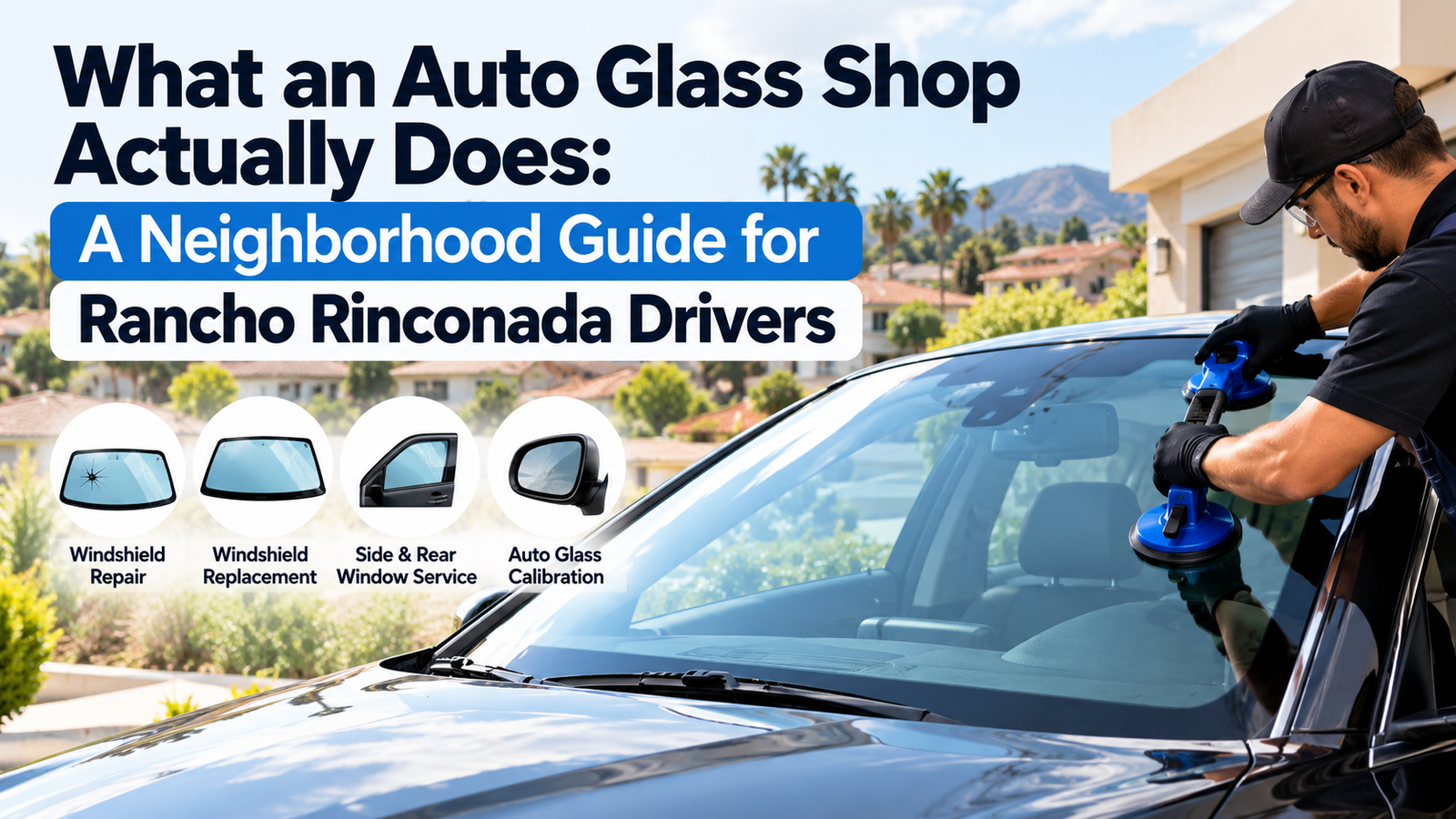
The phrase auto glass covers more than a single repair. A full-service shop typically handles several categories of work.
Chip and crack repair. Small damage to a laminated windshield can often be filled with resin that bonds the fracture and restores clarity and strength.
Windshield replacement. When damage is too large, too deep, or too close to the edge, the entire windshield is removed and a new one is bonded in place.
Side window replacement. Door and quarter windows are usually tempered glass that shatters when broken, so replacement involves cleaning out fragments, installing new glass, and checking the regulator and tracks.
Rear window replacement. Back glass often contains a heating grid and an antenna, so replacement involves electrical connections as well as the glass itself.
Sunroof and panoramic roof glass. These are larger, more complex pieces that may involve seals, drains, and motors.
Mirror glass and trim. Side mirror glass and associated trim pieces are sometimes included in glass-related work.
Calibration of driver assistance systems. Many windshield replacements now require cameras and sensors to be recalibrated.
Related services. These might include moisture and leak diagnosis around bonded glass, replacement of weatherstripping, and inspection of the surrounding body for rust.
Understanding the range explains why shops invest in different tools and training for different tasks.
How a Shop Environment Is Set Up
A dedicated shop has features that are difficult to replicate outdoors, and these affect the work.
A controlled, level floor. A flat, clean surface is important for glass handling and for certain types of calibration where the vehicle must sit at an exact angle to targets.
Climate and dust control. Auto glass adhesive bonds best to clean, dry, correctly primed surfaces. A shop reduces the risk of wind-blown dust, rain, and extreme temperatures.
Specialized tools. These include cutting tools for removing old bonds, glass handling suction cups, primer and adhesive applicators, glass racks, and lighting for inspecting edges.
Parts storage. Shops stock common windshield and side glass types and can access distribution networks for others. Glass is fragile and bulky, so storage and handling matter.
Calibration equipment. Static calibration requires targets, stands, scan tools, and measured floor space. Many shops dedicate an area to this purpose.
Inspection and documentation. Good shops check the glass, seals, and surrounding body before and after the work, and keep records of what was done.
Step by Step: A Typical Windshield Replacement Inside a Shop
The following sequence describes the general approach, though details vary by vehicle.
- Intake and inspection. The glass and surrounding area are examined. Features such as rain sensors, cameras, heated elements, and head-up display layers are noted.
- Protection. Covers are placed on seats, dashboard, and paint to avoid damage.
- Removal of trim and wipers. Cowl panels, moldings, and wiper arms are taken off to access the edges of the glass.
- Cutting the old bond. A cutting tool slices through the urethane adhesive that holds the windshield in place.
- Lifting the old glass. Suction cups are used to lift the windshield away without scratching the paint.
- Preparing the frame. Remaining adhesive is trimmed to a thin, uniform layer, any rust is dealt with, and bare metal is treated with primer. This step is critical, because the new bond depends on a sound surface.
- Preparing the new glass. The edge is cleaned and primed, and brackets or sensors are transferred.
- Applying adhesive. A continuous bead of urethane is laid around the frame, shaped so that it supports the glass at the correct height.
- Setting the glass. The new windshield is lowered into position and aligned within millimeters.
- Reassembly. Trim, wipers, and panels are reinstalled.
- Curing. The vehicle waits until the adhesive reaches safe strength. This period is called the safe drive-away time.
- Calibration and final inspection. If the vehicle has driver assistance cameras, they are recalibrated. The installation is inspected for fit, noise, and leaks.
The care taken in each step affects how well the windshield performs over the life of the vehicle.
Why Newer Vehicles Changed the Job
A generation ago, replacing a windshield was largely a matter of cutting out one piece of glass and setting another. Today the windshield is part of a sensor package.
Forward cameras. Many vehicles have a camera behind the windshield near the rearview mirror that supports lane departure warning, automatic emergency braking, adaptive cruise control, and traffic sign recognition.
Rain and light sensors. These small devices, bonded to the glass, control wipers and headlights.
Heads-up displays. Some vehicles project speed and navigation information onto a special layer in the windshield.
Heated and acoustic layers. Heated wiper parks, acoustic laminates, and infrared-reflective coatings improve comfort but add complexity.
Electric and hybrid vehicles. The Silicon Valley region has a high share of these vehicles, many with large, steeply raked windshields and glass roofs. Their glass is often specific to the model and may carry multiple features.
Each of these features must be matched when glass is replaced, and cameras must be checked or recalibrated. This is a major reason that glass work has become more specialized.
Calibration: A Closer Look
Calibration is the process of making sure that a driver assistance camera sees the road exactly as the system expects. Even a small shift in the camera’s aim can translate into errors at highway distances.
Static calibration is performed with the vehicle stationary. Targets or patterns are placed at specified distances in front of the car, and a scan tool instructs the camera to adjust. It requires level ground, controlled lighting, and accurate measurements, which is why shops often dedicate a bay to it.
Dynamic calibration is performed by driving the vehicle on well-marked roads at set speeds so that the system learns its alignment. It requires good weather and clear lane markings.
Some vehicles require static, some dynamic, and some both. The manufacturer’s procedures determine which applies. After the work, a report or confirmation that the calibration was completed is typically available.
Repair Versus Replacement: How Shops Think About It
Shops generally assess damage using a few criteria.
| Factor | Points toward repair | Points toward replacement |
|---|---|---|
| Size | Chip smaller than a coin, short crack | Large chip, long crack |
| Depth | Outer layer only | Penetrates both layers |
| Location | Away from edges and driver’s main view | Near edge or in direct line of sight |
| Contamination | Clean or can be dried | Dirt or moisture deep in the break |
| Age | Recent | Old and repeatedly flexed |
| Technology | No sensors affected | Damage in the camera zone |
These are general guidelines. Real-world judgment takes into account the specific vehicle and conditions.
Mobile and Shop Service: How They Relate
Many glass providers offer both an in-shop and a mobile option. Chip repair is especially suited to mobile work because it requires portable tools and a short amount of time. Windshield replacement can be done outdoors in suitable conditions, though a shop offers more control and is often preferred when static calibration is needed or when weather is poor.
The best choice depends on the type of damage, the weather, the vehicle’s technology, and convenience. One approach is not universally better than the other.
Local Conditions Around Rancho Rinconada
Several local factors influence what an auto glass shop sees from this part of Silicon Valley.
Freeway commuting. Interstate 280, Highway 85, and Lawrence Expressway carry heavy traffic, including trucks. Following distance and speed make rock strikes common.
Warm summers. Inland Santa Clara County can be hot in the summer, and parked cars heat up substantially. Quick cooling with the air conditioning can stress glass.
Cool evenings and morning moisture. The temperature difference between day and night causes expansion and contraction of glass.
Tree-lined neighborhoods. Falling branches, sap, and seed pods can damage or mar glass.
Construction and development. Ongoing building and road work produce gravel and dust.
EV and technology-rich fleet. A high concentration of vehicles with sensors and cameras means calibration and feature-matching are routine parts of glass work.
Dense parking at shopping centers and apartment complexes. Tight parking increases the odds of door dings and minor impacts.
Quality Indicators in Glass Work
Without making any recommendation, it helps to know the features of careful glass work.
- Clean, even application of adhesive in a continuous bead
- Proper priming of both glass and frame
- Attention to rust and edge condition on the body
- Correct trim and moldings reinstalled without gaps
- Glass with appropriate markings for its position
- Clear explanation of safe drive-away time
- Calibration when required, with documentation
- A final inspection for leaks, noise, and fit
These details reflect process rather than any specific brand or provider.
Aftercare Following Glass Work
After bonded glass is installed, a few precautions help the adhesive cure.
- Keep retention tape in place for the recommended period.
- Avoid slamming doors for a day or two.
- Avoid high-pressure car washes for a few days.
- Do not scrape or peel stickers and trim near the glass edge.
- Watch for leaks, whistling, or loose trim, and follow up if any appear.
Common Misunderstandings
“Glass is glass.” Differences in construction, features, and compatibility matter.
“A windshield is just a window.” It is a structural part and a sensor platform.
“Calibration is optional.” On many vehicles it is needed for safety systems to work correctly.
“A shop is only for replacement.” Repair of chips and short cracks is a core part of the work.
“Once the glass is in, the car is ready.” The adhesive requires time to reach safe strength.
“All shops handle all glass.” Specialty glass, rare models, and certain calibrations may involve extra steps or ordering lead time.
Frequently Asked Questions
What does an auto glass shop do?
It repairs and replaces vehicle glass, including windshields, side windows, rear windows, and roof glass, and often calibrates driver assistance systems after windshield replacement.
What is the difference between laminated and tempered glass?
Laminated glass has a plastic layer between two sheets of glass and holds together when cracked. Tempered glass is a single heat-treated sheet that breaks into small granules.
Why does a newer car need calibration after a windshield replacement?
Cameras behind the windshield support safety features, and even a small change in position can affect how they read the road. Calibration restores the correct aim.
Can a chip be repaired in a shop?
Yes. Small, clean chips that are not too close to the edge are usually good candidates for resin repair.
How long does a windshield replacement take?
The installation itself takes a few hours, but the safe drive-away time and any calibration add waiting time.
Why is the shop environment important?
Adhesive bonding requires clean, dry surfaces and stable conditions, and calibration needs level floors and controlled lighting.
Does hot weather affect auto glass?
Yes. Sun-baked glass subjected to sudden cooling can crack, especially if it has a chip or edge flaw.
What should I watch for after glass is installed?
Look for leaks, whistling, loose trim, or fogging, and follow the aftercare instructions regarding doors, washes, and retention tape.
Final Thoughts
An auto glass shop is a place where chemistry, precision fitting, and vehicle technology meet. The work involves far more than swapping panes. It includes preparing surfaces, applying structural adhesive, matching features, and, increasingly, aligning the cameras that help a car see the road.
For drivers who want to understand how an auto glass shop in Rancho Rinconada fits into the daily life of a Silicon Valley neighborhood, the central ideas are straightforward. Glass is a safety component, damage has predictable causes, repair and replacement follow clear criteria, and newer vehicles add layers of technology that make careful process matter more than ever. A basic grasp of these ideas makes every conversation about glass easier to follow.